Shem Creek Outpost

← The Outpost
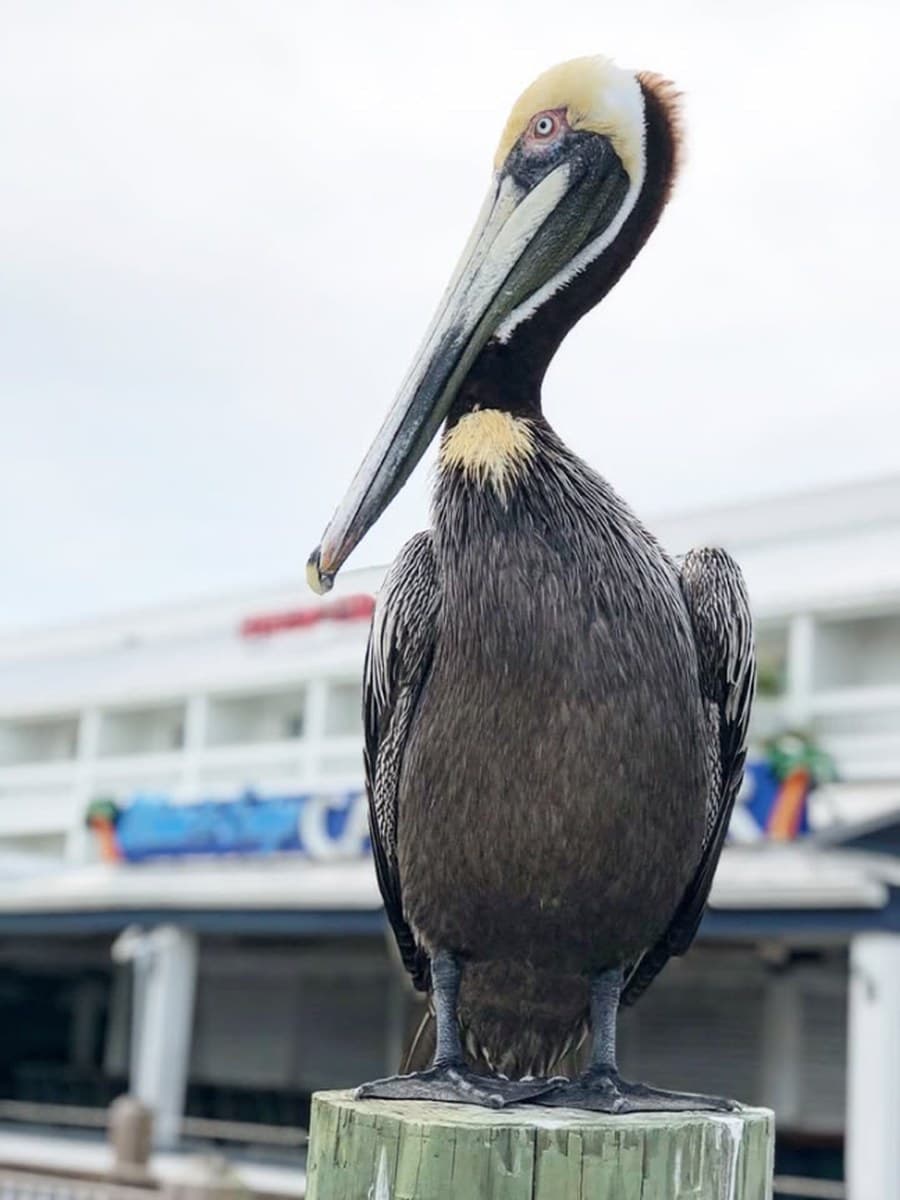
A brown pelican perched on a weathered dock piling on Shem Creek

The Bird on the Piling

The Brown Pelican

Pelecanus occidentalis · Shem Creek, Mt. Pleasant

Stand on the creek long enough and you’ll meet him — a brown pelican hunched on a creosote piling, that long bill folded back against his chest, looking for all the world like he was carved there. He is not rare. He is the everyday face of this working water, lined up along the docks with the shrimp boats, gliding low over the tide. He is also, quietly, one of the best comeback stories on the coast.

Read more

The Story

Nearly Gone, Then Back

It almost went the other way. The pesticide DDT washed into the water, built up in the small fish the pelicans ate, and thinned their eggshells until they cracked under the weight of the birds keeping them warm. By 1970 South Carolina counted fewer than a hundred brown pelicans, and that year the species was listed as federally endangered. The country banned DDT in 1972. A recovery plan followed in 1979. The eggs held again — and on December 17, 2009, after roughly four decades of protection, the brown pelican came off the Endangered Species List entirely. There are now an estimated 650,000 of them, the highest count ever recorded. The bird on your piling is proof it worked.

The Bird

The particulars

Who
Brown pelican, Pelecanus occidentalis
Size
About 3'3" to 5' long, near 7' wingspan
Claim to fame
The only pelican that hunts by plunge-diving
The dive
Headfirst from up to ~65 feet, hitting ~40 mph
Where they nest
Crab Bank, at the mouth of Shem Creek
Off the list
Delisted as endangered, December 17, 2009

How he fishes

The Headfirst Dive

The brown pelican is the only one of the world’s pelicans that hunts by diving from the air — its white-pelican cousin fishes sitting on the surface, but this one drops out of the sky. He climbs, spots a school, and folds into a steep plunge from as high as sixty- five feet, hitting the water at close to forty miles an hour. Air sacs under the skin of his breast cushion the blow, and he twists slightly left on the way down to spare his throat. He stuns the fish, scoops it into that stretchy pouch, tips the seawater out, and swallows. Then he’s back on the piling like nothing happened.

The drop

~65 feet

The height a plunge dive can start from, straight down at a steep angle.

Impact

~40 mph

The speed he hits the water — air sacs under the breast take the shock.

The catch

Stun & scoop

Small fish stunned on impact, then drained and swallowed from the pouch.

Where they nest

The Sandbar at the Mouth

The pelicans crowding the creek don’t come from nowhere. Right at Shem Creek’s mouth, where the water opens into Charleston Harbor, sits Crab Bank — a low seabird sanctuary the birds use to nest. Hurricane Irma chewed it up in 2017, and the nesting went quiet. Then, in December 2021, a restoration project pumped roughly 660,000 cubic yards of dredged sand back onto the bank, adding some thirty-two acres. By July 2025, surveyors counted 155 brown pelican nests out there — the first pelican nesting on Crab Bank since the storm. The squadrons gliding past your table have a home address, and it’s a sandbar somebody chose to rebuild.

More from the Outpost

More from the Creek →

32.7858° N · 79.8636° W